by K9cat | Mar 11, 2020 | Canine Massage, Pain, Scotland

The reason for massage
Buddy was an 8 year old Sheltie who had achieved Grade 5 in agility with one win towards Grade 6. While competing he lost his footing in the tunnel, flipped over and exited on his back. He seemed okay at the time but in the days following his owner noticed that he was refusing to jump up onto the sofa and that he wasn’t running around and playing with the other dogs like he usually did on a walk. In fact, it got so bad that he wanted to be carried after only 20 mins and needed to be lifted on and off the sofa.
Buddy was taken to see a physiotherapist who thought he had damaged his spine and recommended x-rays. He saw the vet and had x-rays done but no injury could be found. And after courses of Metacam and Loxicom had finished he was no better.
It was by chance, about a year later, when visiting another dog in the household that Buddy’s mum asked me take a look at him, having given up all hope anything could be done for him. By this time she was also struggling to keep his weight under control and he was approximately 3kg heavier than he should have been despite being on a restricted raw feed diet.
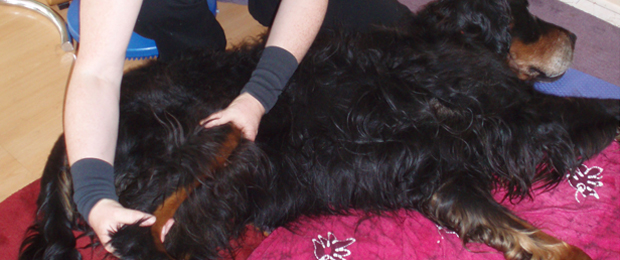
I gave Buddy a superficial palpation I found extensive scar tissue from strains along the muscles that run down each side of his spine, and signs of a strain to one of his Gluteal muscles. I recommended that he would benefit from massage. As a member of the Canine Massage Guild we recommend 3 massage sessions within a 3-5 week period as this yields the best results and if massage is able to improve a condition then you will see improvements within that time.
The outcome / results
It was amazing. After the first session the owner was delighted that Buddy was running on walks and playing like a puppy again. He was also able to go up and down steps comfortably. After the second session he was playing chase with the other family dogs and jumping onto the bed and sofa himself. He now goes on long walks and happily trots along under his own steam. He has also become a very naughty boy again!
Main areas of concern
Bilateral Grade II Strain on Longissimus in the region of T8-T13
Grade II Strain to the Middle Gluteal on the right
Bilateral Trigger Points to the Iliocostalis at the tendon of insertion
Buddy also suffered with areas of over-compensation including: bilateral Trigger Points to the Rhomboids and debilitating wide-radiating Myofascial Pain across the Latissimus Dorsi. Trigger Points to the Tensor Fascia Latae and Myofascial Pain to the right Quadriceps Muscle.
 Bonus weight loss
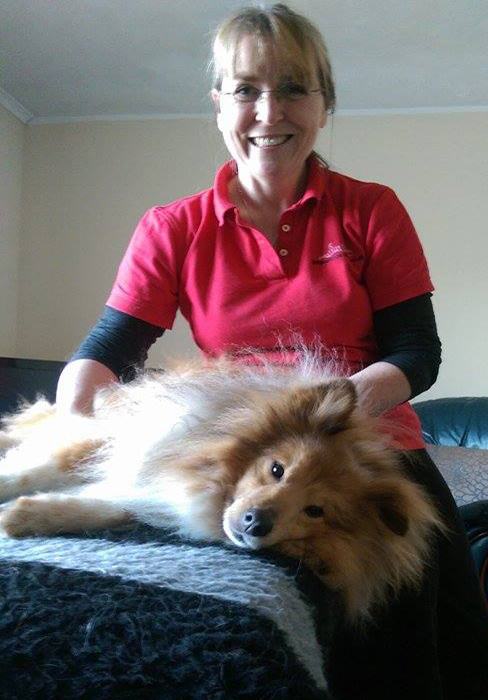
After the initial 3 appointments I then continued to see Buddy monthly to further work on remodelling the scar tissue and since then he has lost over 2kg of weight and is returning to a healthy size for a small Sheltie. There has been no change to his diet but the amount of exercise he enjoys has increased greatly and those stubborn pounds are falling off.
“Over the past year my Sheltie, Buddy, had become very miserable, slow and stiff. Despite taking him to a physiotherapist, having x-rays etc nothing was found and Buddy was getting no better despite being on Yumove. Nothing seemed to make a difference until Catriona treated him and found strains down his back which would be causing a very stiff and sore dog! Well, after one out of 3 treatments the difference is amazing, he is running on walks, he is so much happier and all of a sudden has a spring back in his step. We can’t recommend Catriona enough, anyone who has their dogs treated will know how talented she is, my dogs and I will forever be appreciating her work, thank you Catriona. It is priceless to see our dogs happy.”
Miriam Bogue, Montrose
Buddy’s mum was so happy after the first session that she posted this video of him on Facebook showing him running around enjoying life again!
by K9cat | Mar 11, 2020 | Canine Arthritis Management, Canine Massage, Orthopaedic Condtions, Pain, Scotland

Arthritis, also known as osteoarthritis or degenerative joint disease, affects the joints and is mostly found in older dogs but it can affect younger dogs too. In a healthy joint the facing surfaces are coated with slippery, cushioning cartilage designed to reduce friction and impact. When the cartilage within the joint is damaged it can cause inflammation and further wear to this protective coating. Eventually the bony surfaces may be exposed and their constant rubbing can cause additional bone growth resulting in a visibly enlarged joint, pain, inflammation, and further reduced mobility.
If your dog has canine arthritis then you probably already know all this and are now looking for ways to make your dog more comfortable and bring some joy back into their lives. A lot of owners will have tried physiotherapy, acupuncture and hydrotherapy, or their dogs are already taking the maximum dose of painkillers but they may still be finding daily activities uncomfortable to the point where owners are starting to question their quality of life. People often try canine massage as a last resort.
We recommend an initial 3 sessions of massage close together and we give advice on lifestyle adjustments to support your dog’s progress at home. Often owners have noticed a marked improvement not just in their dog’s mobility but also in their overall demeanor and well being, even after the first session. I hear comments like: “I can see she’s a lot happier and more comfortable”; “He went home and got all his toys out”; “Their cheeky side is back!”; “People in the park have really noticed a difference when we’re out on a walk, she’s holding her head up and there is a spring in her step again”; or “He’s sleeping better, not moving around through the night”. The fact that the dog is feeling better is backed up by the dog’s behaviour when they come for their next appointment and the owner gets dragged across the road in the dog’s eagerness to get to my clinic!
So, if arthritis is an orthopaedic condition why does canine massage, a muscle therapy, give such dramatic results?
Muscles pull on bones to create movement and when a joint starts to lose its full function muscles have to work harder to maintain that movement. Muscles consistently doing a job that they were not designed for will result in tightness, stubborn trigger points, wide-radiating myofascial pain and adhesions.
We refer to these as areas of overcompensation but you may see them as general stiffness, struggling to get up or lie down and tiring easily on walks. Maybe they prefer to be alone and isolate themselves at home or perhaps they have become grumpy with other dogs or people.
Those tight, sore muscles will struggle to remove metabolic byproducts from the tissue. This could be why your dog looks so exhausted.
Clinical canine massage uses a range of recognised techniques to relieve those worn out muscles. We use massage methods to squeeze out those toxins from the muscles and allow fresh, nutrient and oxygen-rich blood flow back in to nourish the muscles. We break down painful trigger points to restore the muscular function and employ myofascial release techniques to break adhesions, relieve pain and improve range of motion.
If you have ever had a good sports and deep tissue massage with some myofascial release and soothing Swedish techniques, then you will know that although sometimes it can be a bit uncomfortable the relief you experience is visible all over your face and will show in how you carry your body. It is exactly the same for your dog. Over the course of a session you can see their face relax and one of the sweetest sounds is when they have a big sigh of relief.
Case study: Ky
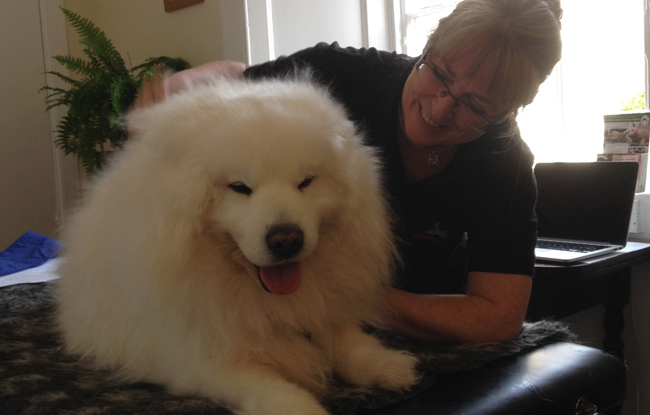
Ky, a 13 year old Samoyed, was referred to me by his vet. He has arthritis in his shoulder, both hips and wrists. He was on Tramadol to ease his pain and had reached a point where his vet’s only option was to change to a more powerful drug. Luckily, Ky’s vet knew all about the benefits of clinical canine massage as he’d brought his own dog to see me and recommended Ky for an initial 3 sessions to see if massage could help.


Ky’s movement was very stiff and he was in a lot of pain despite the Tramadol. As joint function decreases muscles overcompensate. He had chronic trigger points, wide-radiating myofascial pain and adhesions in the muscles and fascia which were working extra hard. Ky was very brave as we worked to relieve the pain, free up the muscles and return them to healthy functioning.
After 3 sessions Ky returned to see his vet, who was so pleased with the results that rather than increasing his medication he was able to take Ky off his regular dose of Tramadol and save it for bad days.
Douglas Paterson of Apex Vets says:
“David (the owner) and I are delighted about the effect that massage therapy has had on Ky (a 13 year old Samoyed with multiple arthritic joints). The addition of regular massage sessions has allowed me to withdraw one drug (Tramadol) from his therapeutic regime, and maintain the same levels of comfort and mobility. This is a fantastic success story for massage.”
Ky’s family are also very happy with the outcome. David Sinclair, Ky’s dad, says:
“Since Ky started massage treatment we have noticed some marked differences in his mobility. The difference to his gait when he walks out of the massage session is the complete opposite as to when he walks in. Ky has arthritis in all 4 of his limbs, he struggles to walk and is in constant pain. But a ‘recovery period’ starts as soon as we get out of the car to go to one of his massage sessions with Catriona. As soon as he realises where he is he literally pulls us up the steps to the front door, and he knows exactly where to go.
Then follows an hour of relaxation and massage for Ky, set with gentle pulling, stretching and massage. Ky really enjoys this and he stays put on the table for as long as needed, occasionally lifting his head if a particularly sore area is being treated. Catriona knows exactly where the sore areas are and uses just the right touch and some soothing words throughout the process. There have been occasions when he has actually jumped into the back of the car without pausing, to go home after a session – something that he is normally unable to do. Usually he has to be lifted in, no mean task seeing as he weighs 30kg. The massage sessions have helped Ky so much that we have been able to discontinue his Tramodol with our vet’s agreement.
In conclusion, Ky enjoys the massage sessions so much, and is like a different dog after one. He walks and moves with much more ease and this seems to last for a few weeks or so. We are so glad that K9 massage was recommended to us by our vet, after we started to think that we’d exhausted all possible treatments.”
What about other therapies?
Hydrotherapy is great when the muscles are ready for exercise. As we’ve already discussed areas of overcompensation can be painful, toxic and debilitating. So before embarking on a hydrotherapy programme I’d recommend a course of massage to free the muscles of painful trigger points and myofascial pain so that your dog can exercise without adding to their muscular stress.
Many vets now offer Acupuncture as a pain-relief option. This is a technique known as dry needling where they insert a needle into the trigger point to help it ‘unwind’ relieving pain and tension.
There are many treatments which can support arthritis and you may need to try a variety or consider a combination for the best results in your dog. I do often hear from clients that without massage they would have lost their dogs years ago so don’t give up hope until you have tried it.
I am part of a network of therapists trained to support this condition and you will know within just 3 sessions if it is going to make a difference to your dog. As with all complementary therapies you will need your vet’s prior approval to ensure that this is an appropriate treatment for your dog. Your clinical canine massage therapist will give you a consent form for your vet to sign.
Further information and links
You can download a pdf explaining how to spot the subtle signs that your dog is in pain. Click here.
Catriona also runs workshops teaching a beginners guide to massaging your own dog. Get more details here.

by K9cat | Nov 28, 2016 | Canine Massage, Gifts, Pain, Scotland
Looking for an original Christmas gift for a loved one?
How about a clinical canine massage session for their furry bestie?
K9 Massage Clinic is now able to offer Gift Vouchers for whatever value you decide. They are valid for 6 months from the date of purchase and redeemable against a Canine Massage Therapy session, no cash refund.
A massage therapy session with K9 Massage Clinic generally lasts an hour and costs £30 (first consultation may last up to one and a half hours, clinics other than Stirling cost £35). This therapy can only be given to dogs with prior Vet Consent, this is a legal requirement and is in accordance with the 1966 Veterinary Surgeons Act. Your Vet Consent form can be downloaded here.
To arrange your Canine Massage Gift Voucher give me a call on 07715 818194.

[hr]

by K9cat | Mar 7, 2016 | Canine Massage, Scotland
The Canine Massage Guild will have their regular stand at Crufts from 10-13 2016.
We’ll be in Hall 1 Stand 26, so please come along to find out about the benefits of canine massage and claim your FREE Muscular Health Check.
Catriona Dickson from K9 Massage Clinic in Scotland will be on the stand every day. She will be happy to answer all your canine massage questions and check your dog over if you have brought one. If you have come from Scotland then do come over and say hello.
For more information visit Canine Massage Guild.
[hr]

by K9cat | Nov 19, 2013 | Canine Massage, Pain, Scotland, The Law and Canine Massage Therapy
When you visit me for the first time you will need to bring a signed vet consent form.
This is in accordance with the 1966 Veterinary Surgeons Act and is designed to keep your pet safe. Signing this form ensures that only qualified people treat on your pet. I adhere to Best Practice and will not work on a dog that has not been cleared by a vet as medically fit to undergo a therapeutic massage.
Please download the form below and ask your vet to sign it.
 Click on the pdf to download.
[hr]